
Understanding Wattage: The Secret to Lower Bills & Safer Homes
Have you ever opened your electricity bill, jaw dropped, wondering, "What on earth used that much power?" You aren't alone.
We often buy appliances based on how shiny they look or how fast they promise to work, but we rarely look at the small print on the back. That tiny sticker holding a number followed by a "W" is the key to understanding your home's energy diet.
I’m Dan, your local Liverpool Electrician. Today, we are going to strip back the jargon. We aren't just talking about saving a few quid (though we will cover that)—we’re talking about wattage, why it matters for the safety of your wiring, and how understanding it can prevent electrical overloads.
Let’s dive in.
What Exactly is a "Watt"? (The Water Analogy)
To understand electricity, it helps to imagine water flowing through a pipe.
Volts (V) are the Pressure: The force pushing the water through. In the UK, this is standardised at roughly 240V.
Amps (A) are the Flow: The volume or thickness of water moving through the pipe.
Watts (W) are the Power: The total work the water can do (like spinning a water wheel).
The relationship is simple. To find the wattage (Power), you multiply the pressure by the flow.
P (Watts) = V (Volts) \times I (Amps)
Why does this matter to you?
Because you don't pay for volts or amps individually. You pay for Watts—specifically, how many thousands of watts you use over time.
Dan’s Pro Tip: Think of Wattage as the "appetite" of your appliance. A high-wattage device is a hungry beast that eats electricity quickly!
The "Heavy Hitters": Which Appliances Cost the Most?
Not all appliances are created equal. Some sip electricity, while others gulp it down. Understanding the difference is the first step to lowering your bills.
1. The Heating Element Heroes (High Wattage)
Anything that generates heat is usually a high-wattage appliance. To make things hot, you need a lot of energy.
Electric Showers: 7,000W – 10,500W (Massive usage!)
Kettles: 3,000W
Tumble Dryers: 2,500W
Hair Dryers: 1,800W – 2,000W
2. The Mechanical Movers (Medium Wattage)
Devices with motors generally use a moderate amount of power.
Washing Machine: 500W – 2,000W (Higher when heating the water)
Vacuum Cleaner: 700W – 1,400W
Fridge/Freezer: 150W – 400W (But remember, these run 24/7!)
3. The Digital Sippers (Low Wattage)
Modern electronics are surprisingly efficient.
LED Lightbulb: 5W – 10W
Laptop Charger: 45W – 85W
Smart Speaker: 2W – 5W
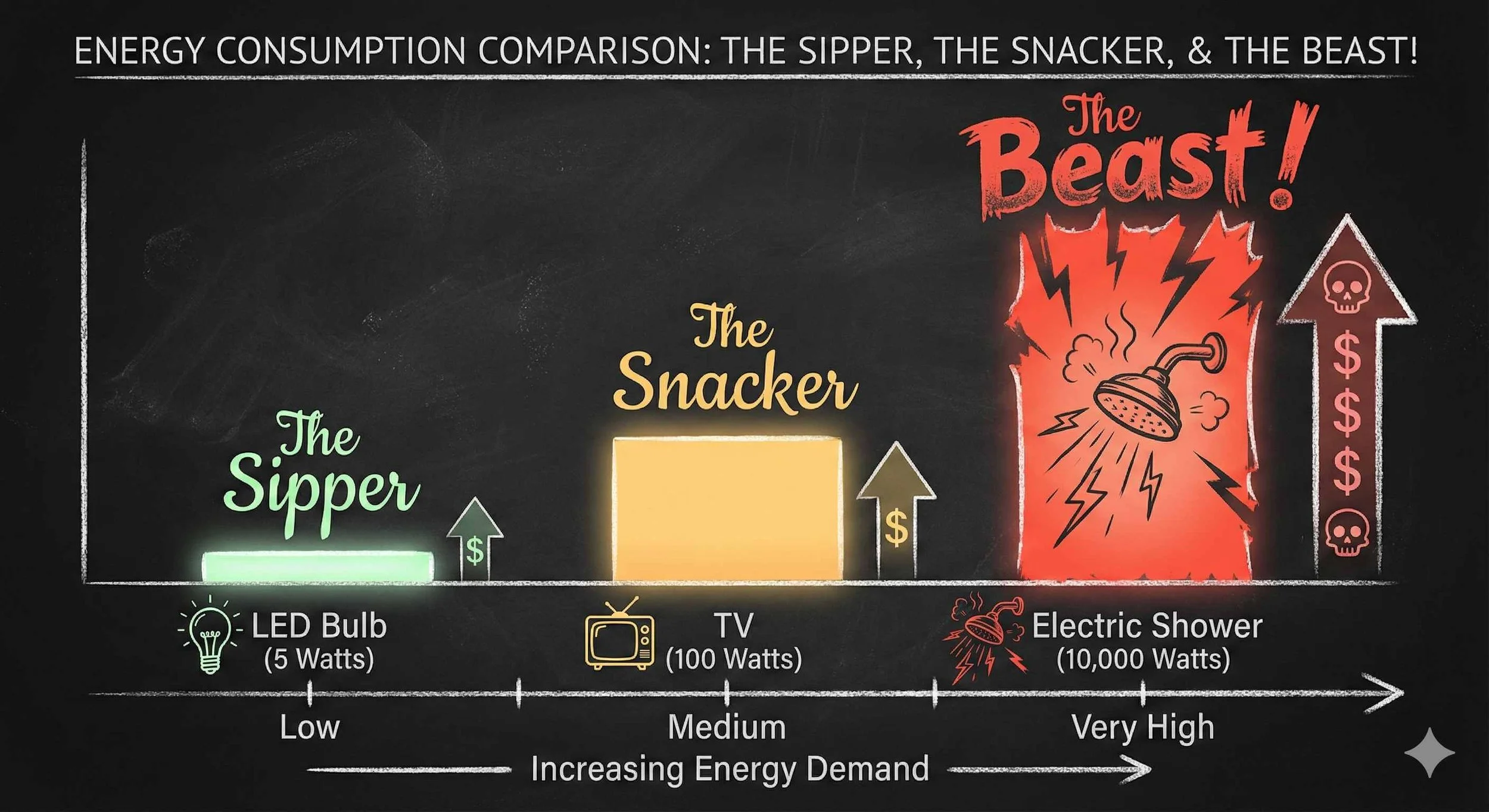
Anything that makes heat (Showers, Kettles, Dryers) eats electricity 100x faster than lights or laptops.
The Math: How to Calculate Running Costs
Here is the formula to work out exactly what an appliance costs you. In the UK, electricity is billed in Kilowatt Hours (kWh).
Find the Wattage (W) on the label.
Divide by 1,000 to get Kilowatts (kW).
Multiply by the hours you use it.
Multiply by your energy provider's Unit Rate (pence per kWh).
The Formula:
Cost=watts/1000 x hours x price/kwh
Real World Example:
Let's say you run a 2,000W electric heater for 4 hours, and your rate is 28p per kWh.
2000W \div 1000 = 2kW
2kW \times 4 \ hours = 8kWh
8kWh \times 0.28 = \pounds2.24
It costs you £2.24 to warm that room for the evening. Do that every night for a month, and that heater alone adds £67 to your bill!
Wattage and Safety: When Good Wiring Goes Bad
This is where I put my electrician's hat on. Wattage isn't just about money; it’s about safety.
Your home’s sockets and extension leads have limits. In the UK, a standard plug socket is rated for 13 Amps, which is roughly 3,000 Watts.
The Danger Zone:
If you plug a heater (2,000W) and a heavy-duty iron (1,500W) into the same extension lead, you are drawing 3,500W.
Result: The fuse in the extension lead should blow.
Worst Case: If the fuse has been tampered with or the extension lead is cheap/damaged, the wire can overheat, melt the insulation, and start a fire.
Signs you are overloading a circuit:
Fuses blowing regularly in plugs.
Circuit breakers tripping at the main consumer unit.
Wall sockets feeling warm to the touch.
A slight burning smell near the socket (See our post on 5 Critical Signs Your Wiring Needs an Upgrade).
Dan’s 3-Step Guide to Efficiency & Safety
1. Audit Your "Vampires"
Appliances left on standby still draw power (often called "Vampire Power"). A TV, microwave, and game console on standby can collectively add up over a year. If you aren't using it, switch it off at the wall.
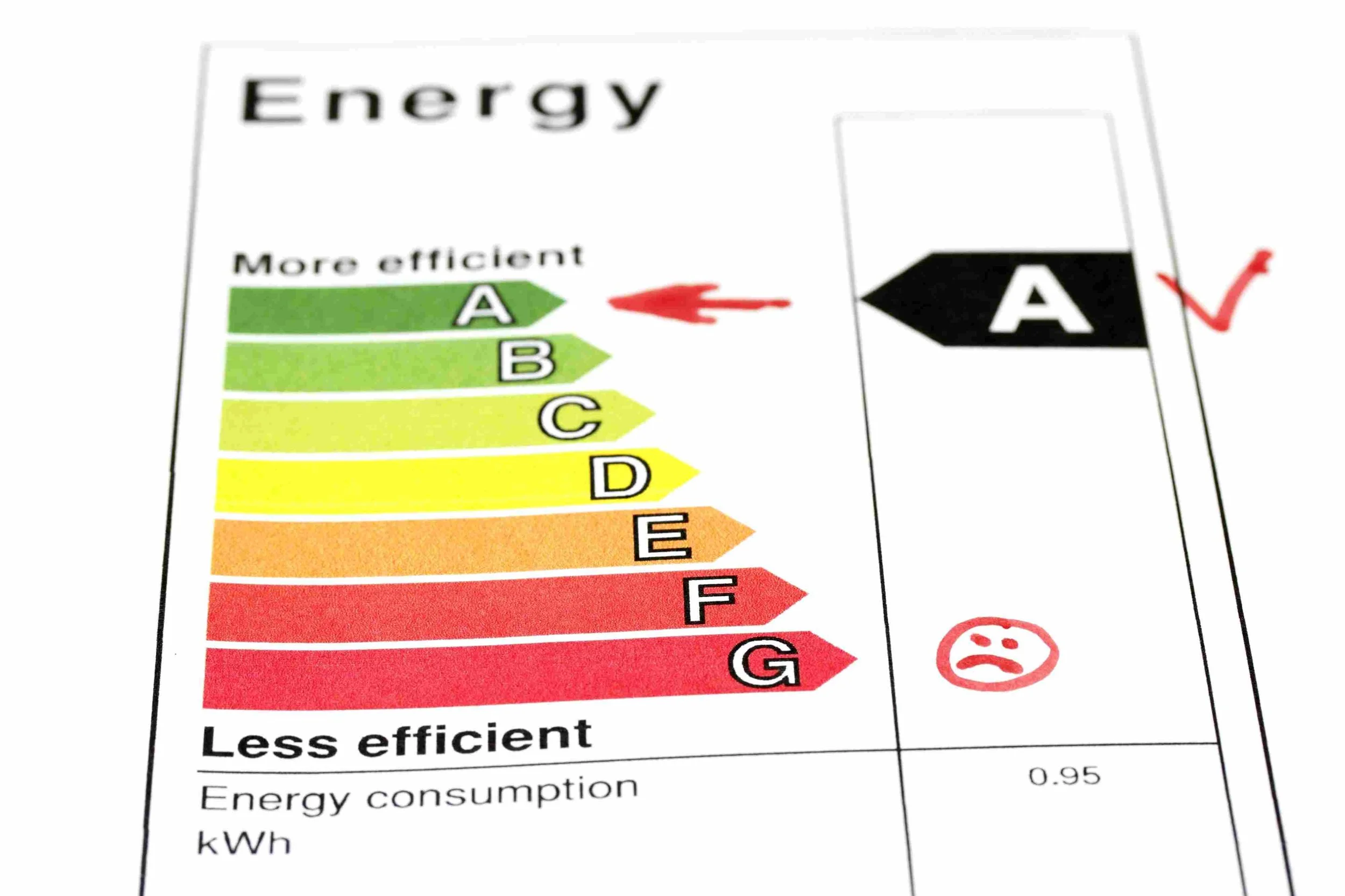
2. Check the Energy Label
When buying new appliances, look at the UK Energy Rating label (A to G). An 'A' rated washing machine might cost more upfront than a 'G' rated one, but the wattage difference will pay for itself in lower bills within a few years.
Never daisy-chain extension leads (plugging one into another). Keep high-wattage appliances (Heaters, Washing Machines, Kettles) plugged directly into the wall whenever possible.
Summary
Understanding wattage gives you the power to control your bills and keep your family safe. By knowing which appliances are the energy-hungry beasts and ensuring you don't overload your sockets, you make your home smarter and safer.
Key Takeaways:
Watts = Power. It’s the "appetite" of the appliance.
Heat costs money. Kettles, showers, and heaters are the most expensive things to run.
Safety limit: Never exceed 3,000 Watts on a single extension lead.
Are your lights flickering when you turn on the kettle? That could be a sign that your circuits are struggling to handle the load. Don't guess—get it checked.
Contact Dan Electrician Today for a Safety Inspection. Let’s make sure your wiring is ready for the load!