The "Death Trap" Install: Why I Refused to Connect a Tesla Charger
Category: Electrical Safety, EV Charging, Real Life Horror Stories Reading Time: 5 Minutes
Yesterday, a client called me for what should have been a routine job. He wanted a Tesla Wall Connector installed. He told me, "The builder has already done the heavy lifting; the supply is there, ready for you to hook up."
I arrived, walked to the meter cupboard, and felt a pit in my stomach.
The client was right—a builder had been there. But what he left behind wasn't a "ready-to-go" supply. It was a fire hazard and a potential electrocution risk rolled into one.
I had to refuse the job immediately. Here is exactly why this installation (pictured below) is illegal, dangerous, and why you should never let a general builder touch your electrics.
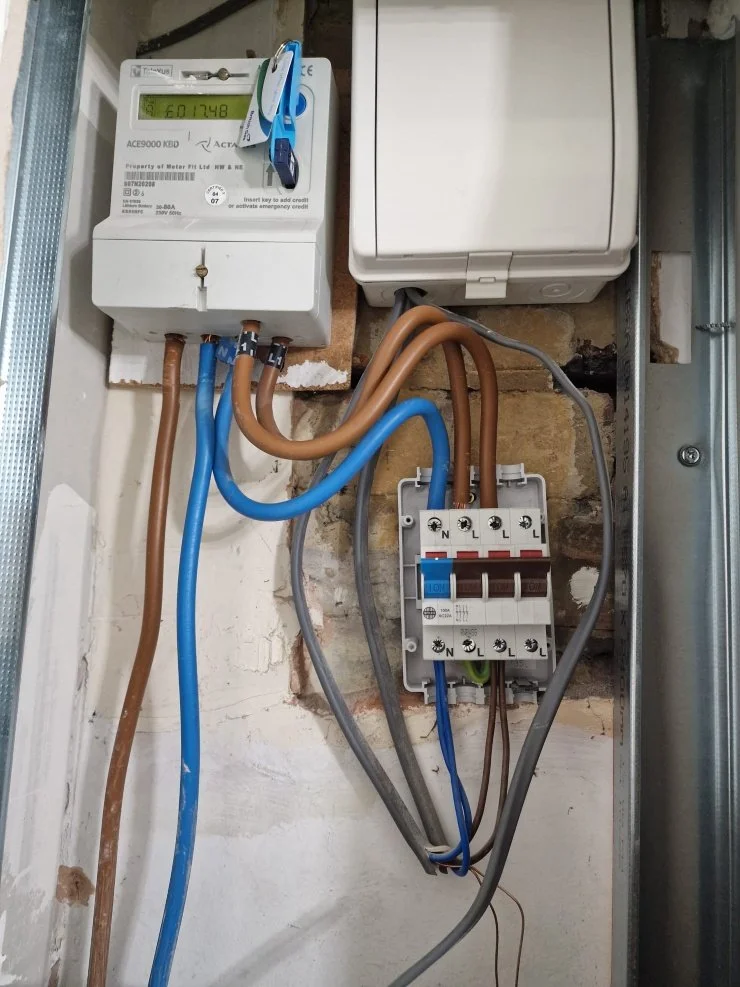
1. The Silent Killer: No Incoming Earth
The most terrifying thing about this installation isn't what you can see—it's what is missing.
There is absolutely no incoming Earth wire connected.
The "Earth" is your primary safety net. If a fault occurs—say, a live wire touches a metal casing—the electricity flows down the earth wire and trips the fuse. Without an earth, the casing becomes live. If you touch it, you become the earth path. Verdict: Immediate danger of death.
2. The "Meltdown" Wire (Undersized Cabling)
The builder installed a single 2.5mm wire from the isolator to feed this new board. Here is the math: A Tesla charger typically draws 32 Amps continuously for hours. A 2.5mm cable is generally rated for around 20-27 Amps max. If I had plugged a car into this, that wire would have overheated, melted its insulation, and likely started a fire within the first hour of charging.
3. Illegal Interference with the Meter
This is a serious legal issue. The builder broke the official seals on the electricity meter. He then supplied his own 100A fuse to install "tails" (the thick cables).
The Problem: These tails are far too long and are completely unsupported. They are literally hanging from the meter, putting massive physical strain on the terminals.
The Law: Only the Distribution Network Operator (DNO) or an authorised meter operator is allowed to touch these seals. This is illegal interference with the supplier's equipment.
4. Exposed Live Copper
If you look closely at the meter tails, you can see visible copper sticking out where they enter the terminals. The insulation has been stripped back too far. In a cupboard where homeowners reach blindly to read a meter or store a vacuum cleaner, exposed live copper at 230V is unforgivable.
5. Zero Cable Protection (The "Razor" Edge)
Cables are entering the consumer unit (fuse box) through jagged holes with no glands, grommets, or protection. Vibration or movement will cause the sharp edges of the box to slice through the cable insulation, causing a short circuit and potentially electrifying the metal box itself.
6. The Missing Tests
Finally, the client confirmed that no testing was done.
No Earth Loop Impedance Test: We don't know if the fuse will trip fast enough in a fault.
No Insulation Resistance Test: We don't know if the cables are damaged inside.
In the electrical world, if you haven't tested it, you haven't installed it. You've just guessed.
The Outcome
I explained to the client that this wasn't just "unsuitable for a Tesla"—it was unsafe for anything.
To fix this, we need to:
Contact the DNO immediately to fix the earthing and reseal the meter.
Rip out the undersized 2.5mm cabling.
Install a proper, fire-rated metal consumer unit with glanded cable entries.
Run correctly sized (6mm or 10mm) cabling supported by cleats.
Test and certify every single connection.
The Lesson: A builder might be great at laying bricks, but when it comes to high-power EV electrics, you need a specialist. Don't risk your home or your life on a "favour" from a builder.
Worried about recent electrical work in your home? If your fuse board looks anything like this, or if you have no certificate for the work, contact Dan Electrician immediately for a safety audit.